


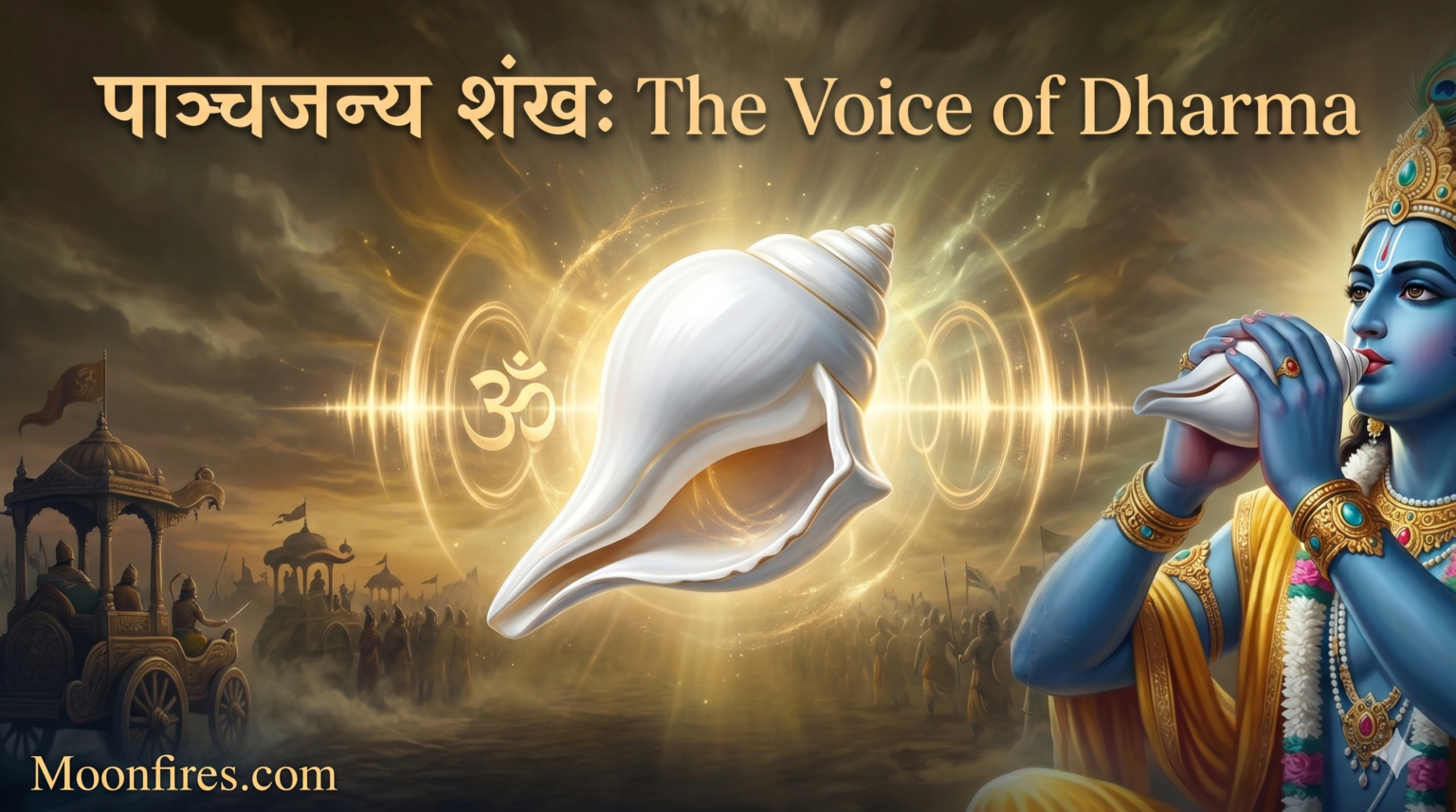
The Divine Resonance: A Comprehensive Exploration of the Panchajanya Shankh
Across the vast and vibrant tapestry of Hindu mythology, few objects command as much reverence, awe, and symbolic weight as the Panchajanya Shankh (पाञ्चजन्य शंख). Known as the celestial conch shell of Lord Krishna the eighth avatar of Lord Vishnu the Panchajanya is not merely an instrument of war or a ritualistic artifact. It is a profound spiritual symbol, a cosmic resonator of truth, and the physical manifestation of divine awakening.
From its mysterious origins in the depths of the primal oceans to its earth-shattering roar on the battlefield of Kurukshetra, the story of the Panchajanya is intrinsically linked to the establishment of Dharma (righteousness) and the destruction of Adharma (evil). This comprehensive article delves deep into the etymology, mythological origins, historical appearances, spiritual symbolism, and enduring cultural legacy of the divine Panchajanya Shankh.
The Etymology and Significance of the Name
To truly understand the essence of the Panchajanya, one must first look at the roots of its name. In Sanskrit, words are rarely arbitrary; they are deeply descriptive of the object’s origin, nature, or purpose.
The word Panchajanya (पाञ्चजन्य) is generally understood to be derived from two root concepts:
-
Pancha (Five): Representing the number five.
-
Janya (Born of / Belonging to): Meaning generated by, born from, or related to.
There are several traditional interpretations of this name within Vedic literature:
-
Born from the Demon Panchajana: The most literal and widely accepted mythological explanation is that the conch was acquired by Lord Krishna after defeating a formidable sea-demon named Panchajana, who lived inside a colossal shell. By claiming the shell of the vanquished demon, Krishna named it Panchajanya.
-
The Five Elements (Pancha Mahabhutas): Philosophically, the universe is composed of five foundational elements: Prithvi (Earth), Jala (Water), Agni (Fire), Vayu (Air), and Akasha (Aether/Space). The Panchajanya is seen as the master sound that harmonizes these five elements. When blown by Krishna, the supreme creator, it signifies his absolute control over the material universe.
-
The Five Classes of Men: Ancient Vedic texts sometimes refer to the “Panchajana” as the five tribes or classes of humanity. In this context, the Panchajanya represents the divine call that addresses all of humanity, uniting them under the universal laws of Dharma.
Regardless of which interpretation one leans toward, the name intrinsically links the conch to cosmic origins, universal balance, and the overarching power of the Divine.

The Mythological Origin: The Quest for Guru Dakshina
The captivating story of how Lord Krishna acquired the Panchajanya is detailed in the Bhagavata Purana (Srimad Bhagavatam). The tale is deeply intertwined with the concepts of duty, devotion to one’s teacher, and the unfathomable power of the Supreme Being.
The Gurukul of Sandipani Muni
During their youth, Lord Krishna and his elder brother Balarama traveled to the ashram of Guru Sandipani Muni in the city of Ujjain (Avantika) to master the Vedas, scriptures, arts, and the sciences of warfare. Though they were divine incarnations who inherently possessed all knowledge, they played the role of perfect human disciples to set an example for the world. They mastered the sixty-four arts in a mere sixty-four days.
Upon the completion of their education, it was time to offer Guru Dakshina, a traditional token of respect and repayment to the teacher. When Krishna asked Sandipani Muni what he desired, the Guru, prompted by his grieving wife, asked for the impossible. They requested the return of their young son, who had been swallowed by the ocean at Prabhasa-tirtha (near the coast of Gujarat) many years ago.
The Encounter at the Ocean
Without hesitation, Krishna and Balarama traveled to the shores of Prabhasa. Krishna commanded the Ocean God, Samudra, to return the boy. Samudra appeared before the Lord, trembling, and explained that he had not drowned the child. Instead, a terrifying Daitya (demon) named Panchajana who possessed the form of a massive, spiraling conch shell (Shankhasura) had ambushed the boy and swallowed him alive in the deep waters.
The Slaying of Panchajana
Hearing this, Lord Krishna plunged into the dark, churning depths of the sea. He tracked the demon Panchajana to his underwater lair. A fierce battle ensued between the Supreme Lord and the formidable sea demon. Ultimately, Krishna slew Panchajana. However, upon tearing open the demon’s belly, Krishna did not find his Guru’s son.
Though the boy was not there, the demon’s physical form a magnificent, pristine, and gigantic conch shell remained. Krishna claimed this resplendent shell, forever naming it Panchajanya.
Retrieving the Son from Yamaloka
Determined to fulfill his Guru’s wish, Krishna realized the boy’s soul had passed into the realm of the dead. Holding his newly acquired conch, Krishna traveled to Patala (the netherworld) and reached the gates of Yamaloka, the kingdom of Yama, the God of Death.
Standing before the gates, Lord Krishna placed the Panchajanya to his lips and blew it for the very first time. The sound was so profound, so devastatingly pure and powerful, that it shook the foundations of the underworld. Lord Yama, recognizing the divine resonance of the Supreme Lord, rushed to the gates to offer his obeisance. Krishna commanded Yama to return the soul of his Guru’s son. Unable to deny the Supreme Creator, Yama immediately restored the boy to life.
Krishna and Balarama returned triumphantly to Ujjain, presenting the resurrected son to a tearful and joyous Sandipani Muni. From that day forward, the Panchajanya became Lord Krishna’s eternal companion, an instrument of divine will.
The Mahabharata: The Roar on the Battlefield of Kurukshetra
While the origin of the Panchajanya is a tale of a student’s devotion, its most famous role is set against the grim and bloody backdrop of the Kurukshetra War in the epic Mahabharata. The conch served as a psychological weapon, a herald of justice, and a symbol of inevitable victory for the Pandavas.
The Opening of the Great War
The first chapter of the Bhagavad Gita known as Arjuna Vishada Yoga (The Despondency of Arjuna) paints a vivid picture of the moments just before the war begins. The Kaurava and Pandava armies are arrayed against each other. To boost the morale of his troops, the Kaurava patriarch, Bhishma, blows his conch shell, which sounds like the roar of a lion.
In response, the Pandava camp unleashes a cacophony of divine conches, signaling that they are ready and fearless. It is here that the text specifically mentions the Panchajanya:
pāñcajanyaṁ hṛṣīkeśo devadattaṁ dhanañjayaḥ
pauṇḍraṁ dadhmau mahā-śaṅkhaṁ bhīma-karmā vṛkodaraḥ
— Bhagavad Gita 1.15
Translation:
“Lord Krishna (Hrishikesha) blew His conch shell, called Panchajanya; Arjuna (Dhananjaya) blew his, the Devadatta; and Bhima (Vrikodara), the voracious eater and performer of herculean tasks, blew his terrific conch shell, called Paundra.”
The verses following this describe the impact of this sound. Verse 1.19 states that the collective sound of the Pandava conches, led by the piercing and supreme resonance of the Panchajanya, shattered the hearts of the sons of Dhritarashtra (the Kauravas). The sound echoed across the earth and sky, tearing through the false confidence of the evil army.
The Psychological Impact
Why did the sound of Panchajanya shatter the hearts of the Kauravas, while it emboldened the Pandavas? The Panchajanya produces the primordial sound of creation, OM (Omkara). For those aligned with Dharma (like the Pandavas), the sound of absolute truth is comforting, uplifting, and protective. It reassured them that God was on their side.
However, for those entrenched in Adharma, greed, and deceit (like the Kauravas), the pure vibration of absolute truth is terrifying. The sound of the Panchajanya was an undeniable auditory declaration that their destruction was imminent. It was the sound of cosmic justice arriving to restore balance.
Signaling Crucial Moments
Throughout the eighteen-day war, Lord Krishna blew the Panchajanya at pivotal moments. For instance, during the killing of Jayadratha, when the sun was hidden by an eclipse created by Krishna’s Maya (illusion) to save Arjuna’s life, the blowing of the Panchajanya served as the signal to Arjuna to release his arrow. Its sound was a constant beacon of divine intervention and strategic mastery.
Physical Description and Iconographic Representation
In Hindu iconography and temple architecture, Lord Vishnu and his avatars are traditionally depicted with four arms (Chaturbhuja), holding four sacred items:
-
Sudarshana Chakra (The Discus) – representing the mind and time.
-
Kaumodaki Gada (The Mace) – representing physical and mental strength.
-
Padma (The Lotus) – representing purity, liberation, and creation.
-
Panchajanya Shankh (The Conch) – representing the origin of existence, space, and divine sound.
The Dakshinavarti Phenomenon
Scriptural descriptions and spiritual traditions often identify the Panchajanya as a Dakshinavarti Shankh (a right-handed conch). Unlike standard conch shells where the spiral expands to the left (Vamavarti), a Dakshinavarti conch expands to the right.
In nature, right-handed conch shells are incredibly rare, occurring at a ratio of about 1 in 100,000 to standard shells. Due to this rarity, Dakshinavarti conches are considered highly auspicious and are associated with Goddess Lakshmi (the goddess of wealth and prosperity). It is believed that keeping a right-handed conch in one’s home invites spiritual and material abundance.
The Panchajanya is described as being blindingly white, radiant as the full moon, and flawlessly smooth. Its size is formidable, fitting for a warrior and a deity, capable of containing immense volumes of breath (prana) to produce an earth-shattering sound.
Deep Spiritual and Philosophical Symbolism
Beyond myth and history, the Panchajanya holds a vast reservoir of philosophical meaning, particularly within the frameworks of Vedanta and Yoga.
The Embodiment of Omkara (Naad Brahman)
According to the Vedas, the universe was created from sound. The primordial vibration from which all matter and energy sprang is OM (AUM). The Panchajanya is considered the physical vessel of this eternal vibration. When blown, the conch shell produces a continuous, resonant hum that mirrors the frequency of OM. In this sense, Krishna holding the conch symbolizes the Supreme Being holding the power of creation, preservation, and dissolution. He is the master of Naad Brahman the universe as sound.
Awakening the Kundalini and Human Consciousness
In the esoteric traditions of Yoga, the human body is viewed as a microcosm of the universe. The blowing of the conch by Lord Krishna symbolizes the awakening call of the Divine to the dormant human soul (Jivatma).
Mankind is often seen as being asleep under the spell of Maya (illusion), caught in the endless cycle of material desires. The piercing blast of the Panchajanya represents a shock to the spiritual system a call to wake up, realize one’s true divine nature, and engage in the righteous battle of life (the internal Kurukshetra). It is the catalyst that forces the dormant spiritual energy (Kundalini) to awaken and rise through the chakras.
Hrishikesha and the Control of Senses
In the Bhagavad Gita verse mentioned earlier, Krishna is referred to as Hrishikesha, which translates to “The Master of the Senses” (Hrishika = senses, Isha = master). It is deeply symbolic that Hrishikesha is the one blowing the Panchajanya. It indicates that true victory in life (whether in an external war or internal spiritual struggle) can only be achieved when one’s senses are entirely under the control of divine wisdom.
Cultural, Ritualistic, and Scientific Significance Today
The legacy of the Panchajanya continues to permeate the daily lives of over a billion Hindus worldwide. The conch shell remains an indispensable part of religious rituals, architectural design, and spiritual practices.
Ritualistic Worship (Puja)
No major Hindu ritual or Puja is considered complete without the blowing of a conch shell. It is traditionally blown at the beginning of ceremonies to purify the environment, chase away negative energies, and invite divine presence. During Aarti (the offering of light), the conch is blown to create an atmosphere of immense auspiciousness.
Furthermore, water stored overnight in a conch shell is considered equivalent to the holy water of the Ganges. During rituals, this sanctified water is sprinkled over devotees and deities for purification, a practice echoing the life-giving, purifying nature of the ocean from which the Panchajanya emerged.
Scientific and Health Perspectives
Ancient sages understood the profound acoustic and health benefits of the conch, framing them in religious contexts.
-
Acoustic Purification: The sound waves generated by a properly blown conch shell are powerful enough to destroy certain harmful microbes and pests in the immediate environment. The specific frequency is said to clear the air of negative psychic energy, promoting mental clarity.
-
Respiratory Health: The physical act of blowing a conch requires significant diaphragmatic strength, breath control, and lung capacity. In Ayurveda and Yogic sciences, blowing a conch is prescribed as an excellent exercise for the lungs, thyroid, and vocal cords. It is essentially a form of intense Pranayama (breath control) that oxygenates the blood and strengthens the respiratory and cardiac systems.
Vastu Shastra
In Vastu Shastra (the traditional Indian system of architecture), the conch shell is a symbol of cosmic harmony. Keeping a conch in the northeast corner of a house is believed to correct energy imbalances, repel malevolent forces, and attract peace. The spiral structure of the shell itself is a manifestation of the golden ratio, mapping the divine geometry that governs the natural world.
In summary
The Panchajanya Shankh is vastly more than an artifact of a bygone mythological era; it is a timeless emblem of truth, duty, and divine awakening. Born from the depths of the ocean, won in a battle against darkness, and used as the supreme herald of Dharma on the blood-soaked plains of Kurukshetra, its story is a mirror to the human journey.
To this day, every time a conch shell is blown in a temple, a home, or by the banks of a sacred river, it is an echo of Lord Krishna’s Panchajanya. It serves as a resounding reminder that no matter how powerful the forces of ignorance and evil may seem, the primordial sound of truth will eventually shatter them. It calls upon humanity to awaken from its slumber, conquer the internal demons, align with righteousness, and listen closely to the divine resonance that constantly hums within the fabric of the universe.