


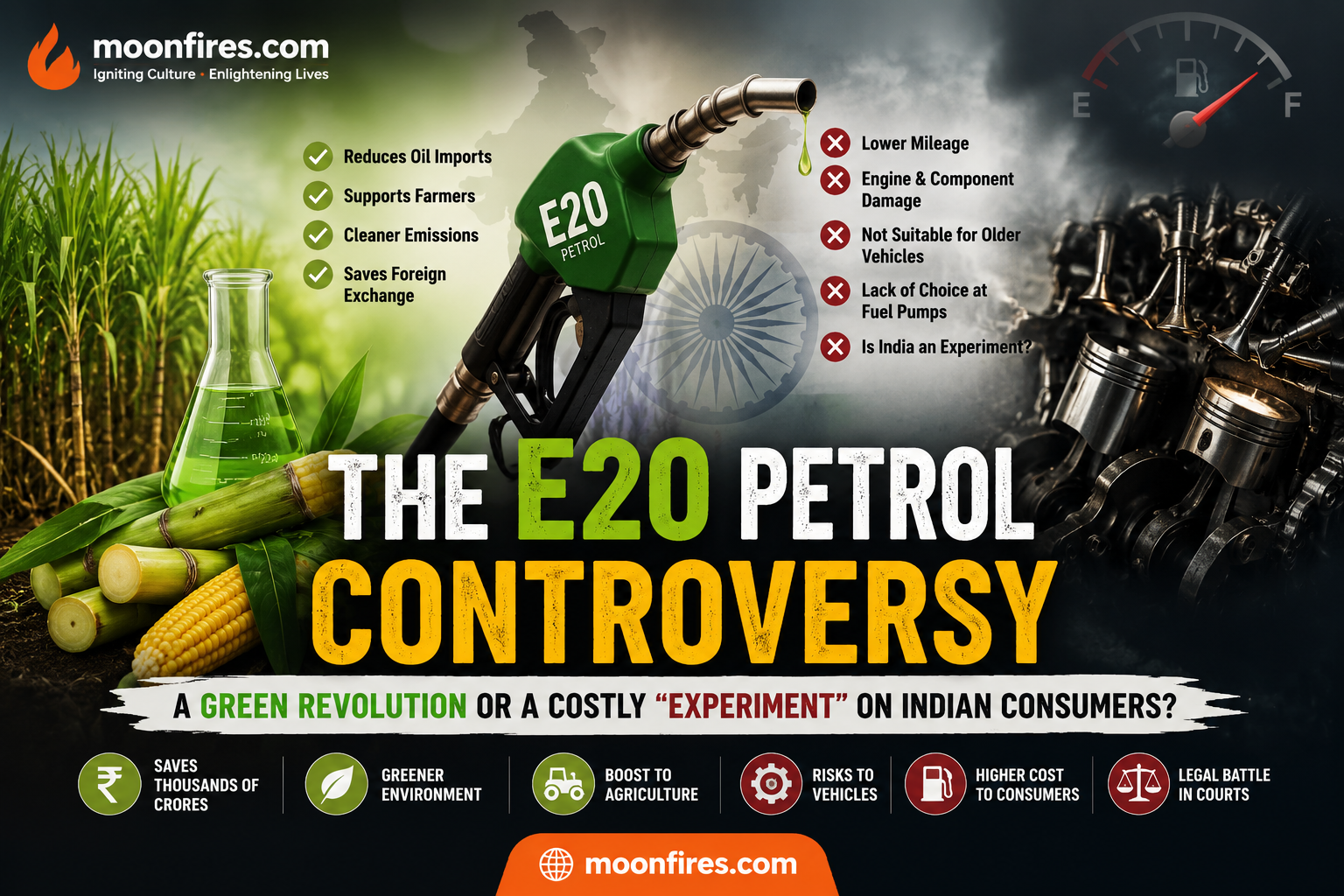
India has moved rapidly towards E20 petrol, a fuel blend containing 20% ethanol and 80% petrol. What was originally planned as a long-term transition has been completed years ahead of schedule, making India one of the fastest countries to adopt higher ethanol blending.
The government’s objective is clear—reduce crude oil imports, support Indian farmers, and lower vehicle emissions. On paper, the policy appears to be a win for the economy as well as the environment.
However, away from official announcements, many vehicle owners have been raising genuine concerns. Questions about engine compatibility, reduced mileage, repair costs, and the lack of consumer choice have continued to grow. The recent observations made before the Supreme Court have added another layer to this debate.
Let’s look at both sides of the issue.
Why the Government Supports E20 Petrol
There are several strong reasons why India decided to increase ethanol blending.
Reducing India’s Oil Import Bill
India imports a significant portion of its crude oil requirements. Every litre of petrol replaced with domestically produced ethanol helps reduce dependence on imported fuel.
According to the Ministry of Petroleum and Natural Gas, ethanol blending has already helped save more than ₹1.4 lakh crore in foreign exchange. From an economic perspective, this is a major achievement.
Cleaner Fuel
Ethanol is produced from agricultural products such as sugarcane, maize, and broken rice. Since it is a renewable biofuel, blending it with petrol helps reduce emissions like carbon monoxide and certain hydrocarbons.
Although it is not a complete solution to pollution, it is considered a step towards cleaner transportation.
Additional Income for Farmers
The policy has also created a steady demand for crops used in ethanol production. This provides farmers and sugar mills with another source of income, especially when there is surplus agricultural production.
Not an India-Only Experiment
The government has repeatedly pointed out that ethanol blending is already being used in countries such as Brazil, the United States, and Japan. In that sense, the concept itself is neither new nor unusual.
Where Consumers Are Worried
While the larger economic benefits are evident, many consumers feel they are paying the price for this transition.
Many Vehicles Were Never Designed for E20
One of the biggest concerns is compatibility.
Most vehicles manufactured before April 2023 were not originally designed for regular E20 usage. This includes many BS-VI vehicles that are only a few years old.
Since E20 petrol is becoming the default fuel at many petrol pumps, owners of older vehicles often have little or no choice.
Possible Damage to Fuel System Components
Ethanol behaves differently from petrol.
It absorbs moisture from the atmosphere and also acts as a strong solvent. Over time, this may affect rubber hoses, plastic fuel lines, seals, and certain engine components that were not designed for higher ethanol content.
In older vehicles, moisture absorption can also increase the chances of corrosion inside fuel tanks and fuel system parts.
Manufacturers have issued different compatibility guidelines depending on the vehicle model, which is why owners are advised to check whether their vehicle is approved for E20 fuel.
Lower Fuel Efficiency
Another practical issue is mileage.
Ethanol contains less energy than petrol. As a result, vehicles running on higher ethanol blends generally deliver fewer kilometres per litre.
For many consumers, this means spending roughly the same amount at the fuel station while travelling a shorter distance.
Lack of Consumer Choice
Another criticism is the absence of clear options at fuel stations.
Several petitions have argued that consumers should be informed about the ethanol percentage in the fuel being dispensed. Without proper labelling or the availability of lower ethanol blends, many vehicle owners feel they are forced into using fuel that may not be suitable for their vehicles.
Supreme Court Proceedings Bring Fresh Attention
The debate became even more intense during a Supreme Court hearing on 30 June 2026.
The matter before the Court involved a dispute over ethanol supply allocations between Bharat Petroleum Corporation Limited (BPCL) and Karnataka-based VINP Distilleries.
During the hearing, Attorney General R. Venkataramani, appearing for the Central Government, stated that the 20% ethanol blending programme is still an ongoing experiment and that its complete impact is expected to become clearer next year.
That statement immediately attracted public attention.
Why Did This Raise Questions?
Only days earlier, the government’s Press Information Bureau had rejected claims regarding engine damage and insurance-related concerns, describing them as misleading.
Against that backdrop, describing the nationwide E20 rollout as an “ongoing experiment” appeared contradictory to many observers.
Critics argue that if the long-term effects are still being evaluated, millions of vehicle owners are effectively bearing the risks while the policy continues to evolve.
The government, on the other hand, maintains that ethanol blending is based on scientific studies and international experience, and that the transition is essential for India’s long-term energy security.
What the Supreme Court Did
The Supreme Court also noted that multiple cases relating to ethanol policy are pending before different High Courts across the country.
The Bench of Justice M.M. Sundresh and Justice Sheel Nagu directed that status quo be maintained regarding ethanol supply allocation for the 2025–26 Ethanol Supply Year, ensuring that the supply chain is not disrupted while the legal issues are examined.
The Court has not ruled on the overall validity of the E20 policy itself, but the ongoing proceedings are likely to influence future policy decisions.
Final Thoughts
The E20 policy reflects a difficult balancing act.
From a national perspective, it helps reduce oil imports, supports farmers, and encourages cleaner fuel. These are important goals that can benefit India in the long run.
At the same time, consumers have legitimate concerns. Vehicle compatibility, reduced mileage, repair costs, and limited fuel choices cannot simply be ignored.
For the transition to succeed, public confidence is essential. That means transparent communication, proper fuel labelling, clear manufacturer guidance, and practical options for owners of vehicles that are not designed for E20.
The debate over E20 is no longer just about fuel. It is about how major public policies should balance national interests with consumer protection.